Here’s a summary of what’s going on with the EUR/USD, the Federal Reserve (Fed) and the broader market, along with what to watch for next:
✅ What happened
-
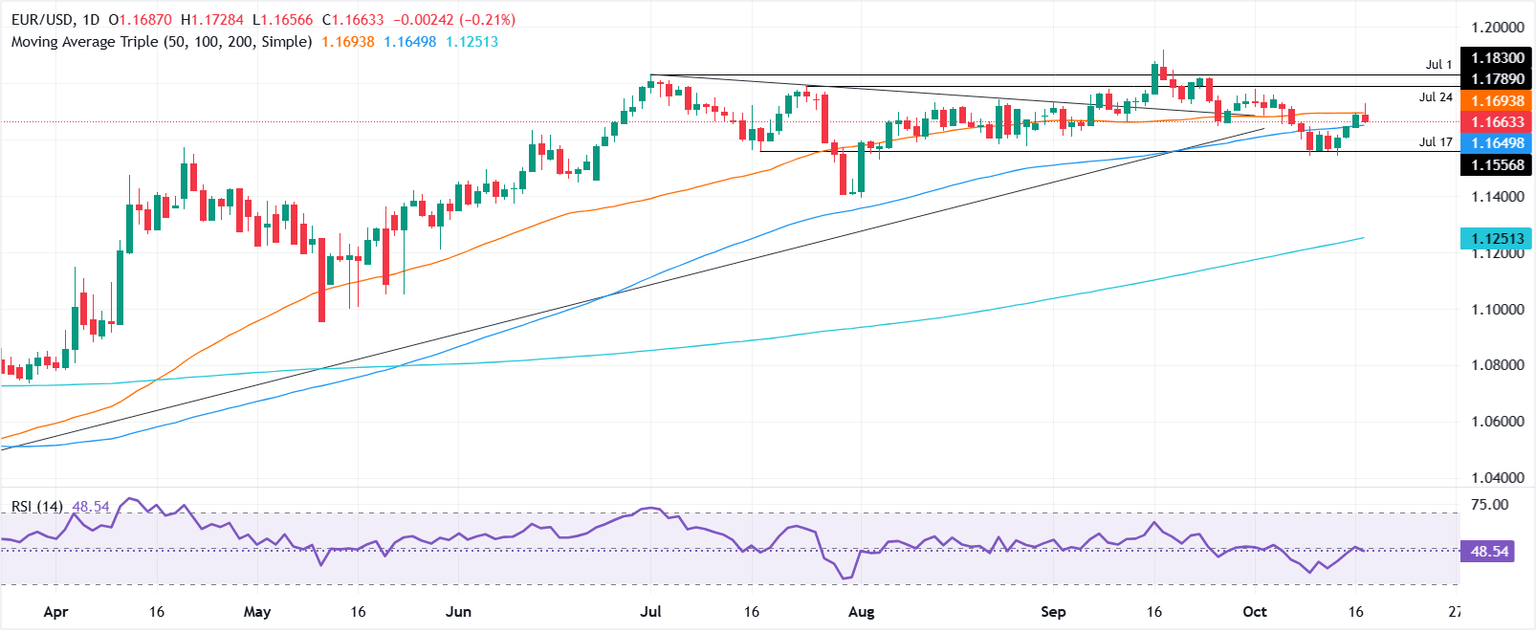
The EUR/USD pair slipped by around 0.17 % during the North American session as the US dollar recovered some ground. (FXStreet)
-
US President Donald Trump said that very high tariffs on China are “not sustainable,” signalling a softer stance on trade tensions with China. (FXStreet)
-
As a result, the US dollar (via the US Dollar Index “DXY”) recovered modestly – up ~0.09 % to ~98.42 in one report. (FXStreet)
-
On the Euro side, euro-zone inflation data (HICP) came in broadly in line with expectations: core HICP +0.1 % m/m, +2.4 % y/y (slightly above the +2.3 % forecast). (Mitrade)
-
Fed officials (like Christopher Waller, Alberto Musalem, Neel Kashkari) signalled support for further rate cuts, but emphasised that inflation remains elevated. (FXStreet)
🔍 Why this matters
-
Trade rhetoric matters for currencies: When tariffs or trade threats escalate, risk sentiment usually falls and the US dollar either strengthens (safe-haven demand) or weakens depending on how markets interpret the fallout. Here, the softer tariff stance reduced one source of uncertainty, which helped the dollar recover.
-
The EUR/USD pair is very sensitive to both US monetary policy and Eurozone fundamentals. The fact that US inflation remains sticky means the Fed may be less aggressive in cutting rates than markets had hoped — which supports the US dollar. Meanwhile, the Eurozone inflation being in-line means the euro doesn’t get a strong positive shock.
-
Technical levels: According to one note: support for EUR/USD is around 1.1648 (100-day SMA) and then 1.1600, 1.1550. Resistance is around 1.1691, 1.1700 and the recent high ~1.1728. (FXStreet)
🎯 What to watch going forward
-
US Inflation (CPI): A major upcoming data point is the US CPI release next week. If inflation comes in stronger than expected, the Fed may signal delay in cuts → dollar strength → EUR/USD could drop. (FXStreet)
-
Fed commentary & rate path: If Fed officials shift tone toward less cutting (or even hint at pausing) that will support the dollar.
-
Eurozone data & policy: If inflation weakens significantly, then the European Central Bank (ECB) might lean toward easing earlier, which would weigh on the euro.
-
Trade / geopolitical risk: Even though Trump softened his stance, trade tensions can flare up quickly. Any new strong rhetoric or escalation will likely boost the dollar again.
-
Risk sentiment / safe-haven flows: If markets get nervous (e.g., due to banking stress, global growth fears), the dollar can benefit as a safe-haven.
📌 Bottom line
The recent slip in EUR/USD is largely because:
-
The dollar regained strength after trade‐risk concerns eased,
-
The euro got no standout positive catalyst,
-
Markets remain cautious about inflation and monetary policy.
If US inflation remains high or the Fed signals caution on cuts, the dollar stands to stay strong and EUR/USD could head lower (toward 1.16 or below). Conversely, if inflation drops sharply or the eurozone shows stronger data, the euro could stabilise or rebound.
If you like, I can pull the latest live chart and technical indicators for EUR/USD (support/resistance, moving averages) for you right now.

Post a Comment